


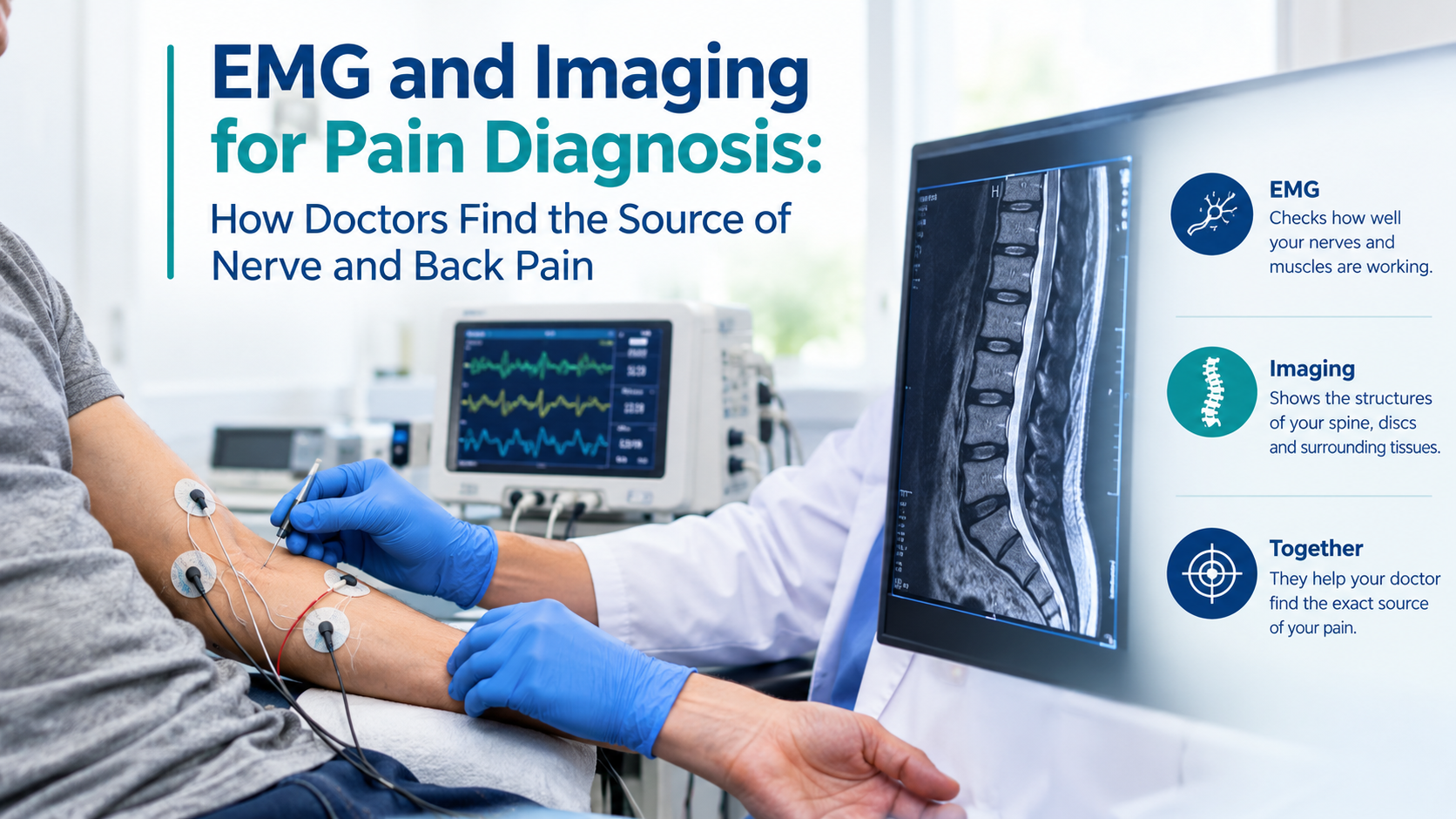
When pain has no obvious cause, it wears you down fast. You start to wonder if it’s all in your head, or if anyone will ever figure it out. Doctors usually turn to two kinds of tests to get answers. EMG checks how your nerves and muscles are working. Imaging shows what your spine and soft tissues look like. Put the two together and treatment can go after the actual problem, not just the symptoms.
How Is Pain and Nerve Pain Diagnosed Through Diagnostic Testing?
It starts with a conversation. Your provider will ask when the pain began, where it travels, what eases it, and what makes it worse. They’ll also want to know about any numbness, tingling, or weakness. Then comes the physical exam, where they check your reflexes, strength, sensation, and how you move.
Sometimes that’s enough to land on a working diagnosis. If it isn’t, or if the pain is severe or just won’t let up, testing is the next step. Tests fall into two groups:
- Functional tests, like nerve testing, show how well your nerves and muscles are doing their job.
- Structural tests, like X-rays, MRI, and CT scans, show how your bones, discs, and soft tissue are arranged.
What Is an EMG Test for Nerve Pain and What Does It Diagnose?
Electromyography (EMG) records the electrical activity in your muscles and the nerves that control them. It’s usually paired with nerve conduction studies (NCS), which measure how fast and how strongly signals travel along a nerve. Together they can tell your doctor whether a nerve is irritated, pinched, or damaged, and how serious it is.
What Happens During an EMG Test?
There are two parts. In the nerve conduction part, small electrodes are placed on your skin and send a mild electrical pulse. Most people say it feels like a quick tap or a tingle. In the EMG part, the doctor slips a thin needle into a few muscles and records their activity while you rest and then move lightly. It can sting for a second, but most people get through it without trouble. Plan on 30 to 60 minutes, and you can carry on with your day afterward.
What Conditions Can EMG Help Evaluate?
- Pinched nerves and radiculopathy, including sciatica
- Carpal tunnel syndrome and similar nerve entrapments
- Peripheral neuropathy, which is often linked to diabetes
- Muscle disorders, and weakness with no clear reason
- Nerve injury after trauma or surgery
What Is Diagnostic Imaging for Pain and Why Is It Used?
Imaging lets your doctor see inside your body without any surgery. The common options are:
- X-ray: bone alignment, fractures, arthritis, and spinal curvature
- MRI: detailed views of discs, nerves, the spinal cord, ligaments, and muscle
- CT scan: cross-sections of bone, useful when an MRI isn’t an option
- Ultrasound: a live look at tendons, muscles, and some nerves
Imaging earns its keep when a doctor suspects a herniated disc, spinal stenosis, a fracture, or another structural problem. It can show exactly where a nerve is being squeezed, whether that’s by a disc, a bone spur, or a canal that has narrowed.
EMG vs Imaging: What Is the Difference?
The short version is that imaging shows structure and EMG shows function.
An MRI might pick up a bulging disc, but it can’t tell you if that disc is really bothering a nerve. Lots of people with no pain at all have bulges or wear and tear on their scans. EMG can show whether a nerve is truly disrupted and which nerve root is involved. The reverse is also true. Imaging can reveal the cause behind something EMG can only hint at.
Neither test is better than the other. They answer different questions, and when both line up with your symptoms and exam, your doctor can be far more confident in the diagnosis.
When Might You Need an EMG or Imaging Test?
Your provider may bring up testing if you have:
- Pain, numbness, or tingling that runs into an arm or leg
- Muscle weakness, such as foot drop or hand drop
- Back or neck pain that hangs on for several weeks despite treatment
- Symptoms that began after an injury, fall, or accident
- Pain that wakes you at night or keeps getting worse
- Earlier test results that didn’t add up
Head to the emergency room if you have sudden weakness, lose control of your bladder or bowels, feel numbness around the groin, or have severe pain after major trauma.
How Do EMG and Imaging Help Guide Pain Treatment?
Once your doctor knows which nerve or structure is behind the problem, treatment gets a lot more targeted:
- Physical therapy and exercise built around your diagnosis
- Medication management
- Image-guided injections, such as epidural steroid injections or nerve blocks
- Minimally invasive procedures
- A referral for a surgical opinion, if that makes sense
Testing also helps rule things out, and that matters just as much. Knowing what isn’t causing your pain can spare you treatments you don’t need and give you a more realistic idea of what recovery looks like.
What Happens During a Pain Diagnostic Evaluation?
- Medical history review: your symptoms, past injuries, and what you’ve already tried
- Physical and neurological exam: strength, reflexes, sensation, and movement
- Selected testing: imaging, EMG/NCS, or both, depending on what the exam turns up
- Results discussion: your provider walks you through the findings and how they fit your symptoms
- Personalized plan: treatment matched to your diagnosis and your goals
You won’t always need every test. A good specialist only orders the ones that are likely to change your treatment.
What Conditions Can Be Evaluated With EMG and Imaging?
- Herniated or degenerated discs
- Sciatica and lumbar radiculopathy
- Cervical radiculopathy (arm pain that starts in the neck)
- Spinal stenosis
- Carpal tunnel and other nerve entrapments
- Peripheral neuropathy
- Sacroiliac and facet joint problems (mostly found through imaging)
- Nerve problems after injury or surgery
When Should You Talk to a Pain Specialist?
Book an appointment if your pain has gone on for more than a few weeks, keeps coming back, or spreads into your arms or legs. The same goes if it’s getting in the way of your sleep, your work, or your everyday life. Numbness, tingling, or weakness are good reasons to call too, as is imaging that doesn’t seem to match how you feel. Getting checked early often means getting relief sooner.
Final Thoughts
Pain is rarely simple, and no single test explains all of it. A careful exam, nerve testing, and imaging work best as a team, and together they help doctors work out what’s really going on and plan around it. If you’re tired of living with pain nobody can explain, a proper diagnostic evaluation is a solid place to start.
The team at Restore Spine and Pain can look at your symptoms, recommend the right tests, and build a treatment plan that fits you. Schedule a consultation and start getting answers.
FAQs
How does EMG help diagnose nerve pain?
An EMG records the tiny electrical signals your muscles produce. Paired with a nerve conduction study, which checks how quickly and cleanly your nerves send signals, it gives your doctor a clear read on what’s going wrong. If a nerve is pinched or damaged, or if the problem is actually in the muscle, the pattern shows up on the test. It also helps pinpoint exactly which nerve is the troublemaker.
When is an EMG test needed for pain?
Usually when you’ve got pain that shoots or radiates, or you’re dealing with numbness, tingling, or a feeling of weakness and nobody can say why. It’s also a common next step when your MRI or X-ray looks fine (or shows something that doesn’t fit what you’re feeling).
What is the difference between EMG and imaging?
Think of imaging as a photo and EMG as a performance check. MRI and X-ray show what your spine and the surrounding tissue look like. EMG shows how your nerves and muscles are actually working. Doctors often use both, since one can answer what the other can’t.
Do I need an EMG or imaging for back pain?
Not always. Most back pain eases up on its own within a few weeks with simple self-care. Tests usually come into the picture if the pain hangs around, travels down into your legs, comes with weakness, starts after an injury, or shows up alongside warning signs like fever or loss of bladder control.
What tests are used to diagnose nerve pain?
The usual ones are EMG with nerve conduction studies, MRI, CT, X-ray, and ultrasound. But tests are only part of it. Your doctor will also listen to your story, do a hands-on neurological exam, and then decide which tests make sense for you.