


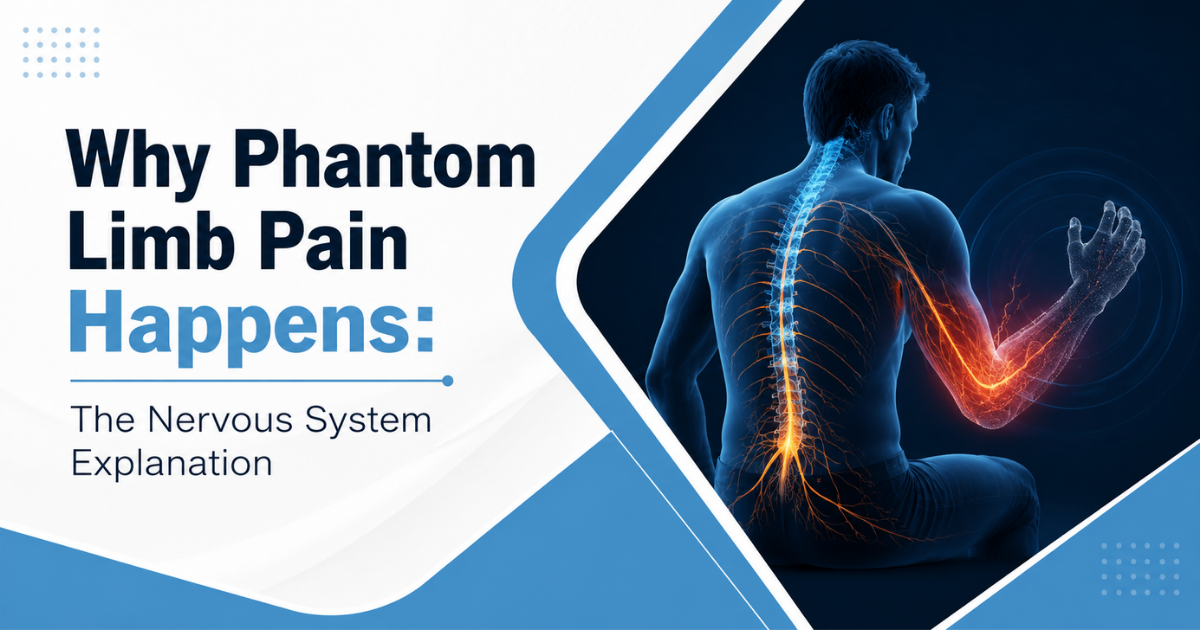
If you’ve lost a limb — or you love someone who has — you’ve probably run into this strange phenomenon called phantom limb pain. Real, sharp, sometimes unbearable pain, coming from a hand or a foot that simply isn’t there anymore. It sounds like it shouldn’t be possible. How do you hurt somewhere you don’t have?
Turns out, the missing limb was never really the source of the problem. The story is happening up in the brain and nervous system, which — as strange as it sounds — doesn’t always get the memo that the limb is gone. Here’s what’s actually going on, without the medical jargon.
Your Brain Has a Map of Your Whole Body
Somewhere in your brain, there’s essentially a map of you — every finger, every toe, your face, your back, all of it, wired in from a lifetime of feeling things happen to your body. That map lives mostly in a region called the somatosensory cortex.
When a limb is amputated, the signals coming from that limb stop cold. But the map itself doesn’t just get erased. Your brain still “expects” that limb to be there, because that’s what years, maybe decades, of wiring have told it. And that gap — a brain that still believes in a limb the body no longer has — is basically where phantom sensations start.
The nerves at the injury site don’t just shut off.
They’re cut, and the raw ends can get irritated — sometimes clumping into little bundles called neuromas — and keep firing signals up to the brain. The brain reads those signals the only way it knows how: like they’re still coming from the limb. That’s why phantom pain feels so specific — a cramping foot, a clenched fist — because the signal’s riding on pathways built for exactly that sensation.
The brain also “rewires” itself, a little messily.
The part of the brain that used to handle that limb doesn’t just sit empty — nearby areas start creeping into that space. It’s called cortical remapping, and the more it happens, the worse the pain tends to get. Almost like the brain gets its wires crossed while reorganizing, and that crossed-wire moment is felt as pain.
The spinal cord piles on too.
It can get more sensitive after amputation — nerve pathways start firing more easily, even without much of a trigger. Add it all up — cranky nerve endings, a jumpy spinal cord, a brain still holding an outdated map — and you get pain that feels completely real, because it is.
And no, it’s not “in your head.”
It’s physical, rooted in actual nerve and brain activity. Which is exactly why treatment works better when it targets the biology — not the mind.
Treatment usually means hitting more than one of these points at once:
- Calming the irritated nerves at the injury site
- Settling down that spinal cord sensitivity
- Helping the brain re-map itself (mirror therapy is one way)
- Sometimes, more targeted procedures from a pain specialist
No single fix works for everyone — but understanding where the pain’s actually coming from is usually the first real step toward getting it under control.
Frequently Asked Questions
Is phantom limb pain the same thing as phantom limb sensation?
Not exactly. Phantom sensation is just the feeling that the limb is still there, which is incredibly common after amputation and usually isn’t painful at all. Phantom limb pain is specifically about pain — burning, cramping, shooting sensations — coming from that missing limb.
How common is this, really?
More common than most people expect. A large share of people who go through an amputation deal with some degree of phantom limb pain, especially in the months right after surgery — though how intense it is, and how long it lasts, varies a lot from person to person.
Does it ever just go away on its own?
For some people, yes — it fades as the nervous system settles. For others, it sticks around for years and needs active treatment. There’s no set timeline, which is part of why care really has to be tailored to the individual.
Can this happen with other injuries, not just amputation?
It can. Similar patterns show up after nerve injuries, spinal cord injuries, and sometimes with paralysis — anywhere the brain’s body maps and the actual signals coming from the body stop matching up.
Does mirror therapy actually work?
For a lot of people, yes. It uses a mirror to create the visual illusion that the missing limb is there and moving normally, which can help the brain recalibrate its map and ease the pain. It’s not a guaranteed fix for everyone, but it’s helped a meaningful number of patients.
Are there medications that help?
Yes — usually nerve-pain medications rather than standard pain relievers, since the source is nerve and brain activity rather than damaged tissue in the usual sense. A pain management physician can help figure out what fits a particular case.
What about nerve blocks or injections?
For some patients, targeted treatments aimed at the nerves near the amputation site can meaningfully cut down on pain signals, especially when a neuroma is part of the picture. This is often something a pain management specialist will discuss as part of a bigger plan.
Does phantom limb pain mean something’s wrong with healing?
Not usually. It’s a well-known, fairly common part of how the nervous system reacts to amputation, not a sign that something’s gone wrong. That said, any new or worsening pain is worth getting checked, since occasionally it does point to something else, like infection or a problematic neuroma.
When should someone actually see a specialist for this?
If it’s messing with sleep, daily life, or recovery, it’s worth bringing to a pain management physician. Since the pain comes from several places in the nervous system at once, a specialist can build a plan that tackles it from more than one angle instead of relying on just one approach.