


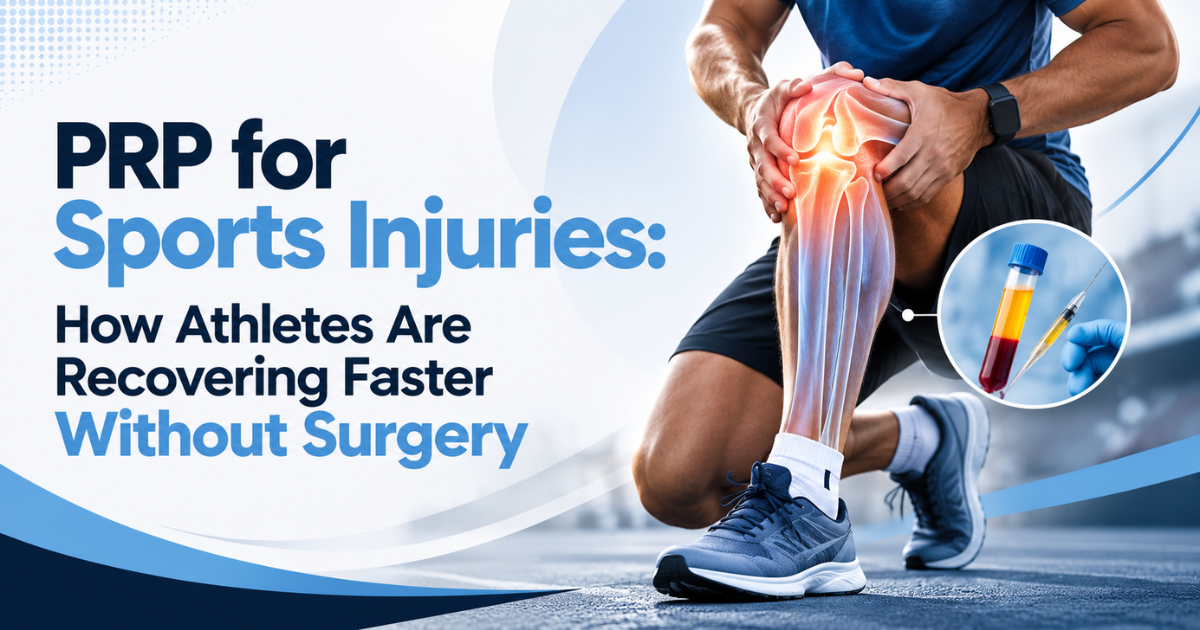
They will always do more than the common man — but when hurt, all they desire is to resume their journey towards recovery through smart rehabilitation rather than simply sitting back and letting everything settle down on its own. This is why PRP therapy has gained popularity in the last decade.
Across different spectrums from amateurs to professionals, PRP therapy is being employed to treat sports injuries to increase the speed of healing, reduce chronic inflammation, and get the player back into his passion without going under the knife straight away.
Why Is It Difficult to Treat Sports Injuries?
Most sports injuries usually target tendons, ligaments, and cartilage, which tend to have a restricted blood supply. This means that less nutrition and repair cells get to the tissues for healing purposes. Consequently, the process takes too long, leaves the injury incompletely healed, or even leads to chronic pain.
Traditional forms of treatment include resting the body part, icing it, using anti-inflammatory drugs, and performing physiotherapy sessions; however, these do not necessarily speed up the healing process. This is where PRP comes in.
Role of PRP in Recovery from Sports Injuries
The PRP technique involves isolating platelets in an athlete’s blood and then injecting them into the affected tissues. This leads to growth factors secreted by the platelets to create an environment for healing through:
- Making fibroblasts more active, as they are the key producers of collagen for tendons and ligaments
- Facilitating angiogenesis for better circulation in affected tissues
- Reducing chronic inflammation but not inhibiting the healing process
- Drawing in reparative cells such as stem cells to the injury site
In this way, PRP enhances the healing process for athletes, and recovery becomes quicker than would have been possible with conventional approaches.
Common Types of Sports Injuries That Are Best Treated by PRP
Tendinopathies
Tendinopathy – which is basically the chronic degeneration and inflammation of a tendon – is probably the most common form of overuse injury in the world of sports. The following conditions have been extensively researched for their effectiveness in relation to PRP:
- A common condition among basketball, volleyball, and runner athletes. Studies have indicated that PRP helps alleviate pain and improve the structure of patellar tendons.Patellar tendinopathy (jumper’s knee):
- Quite common among running athletes and field athletes. The evidence shows PRP as an effective remedy for mid-portion Achilles tendinopathy especially when the patient has not responded to eccentric exercises.Achilles tendinopathy:
- Classic example of overuse injury among racquet games players and manual workers. PRP beats cortisone hands down in cases examined in many studies.Tennis elbow (lateral epicondylitis):
- This is another name for lateral epicondylitis. PRP has proven effectiveness in treating this condition in athletes that do not respond to rest and physical therapy.Golfer’s elbow (medial epicondylitis):
Ligament Sprains
Grade I and Grade II ligament sprain, which means that the ligament suffers stretching or partial tear but not a complete tear, is a good choice for PRP.
Typical uses for this treatment include sprains of the ankle ligaments (the most common injury in sports), MCL injuries to the knee joint, and UCL injuries sustained during throwing activities.
Partial Muscle Tears
PRP may help in treating muscle tears due to its ability to enhance muscle fiber regeneration while decreasing scarring. Such cases include various levels of muscle strain injuries, including partial tears that have occurred in athletes competing at the highest possible performance level.
Labral Tear in Shoulder and Hip Joints
Both shoulder and hip joint labral tears have gained increasing attention in athletes. Although some severe cases might need surgery, research indicates that PRP could be used in conjunction with surgical intervention. PRP can either work independently on partial tears of the labrum or aid in post-surgery recovery.
PRP Therapy and Return to Sport: What the Latest Research Reveals
Clinical outcome studies on PRP in athletes are becoming more frequent. In tennis elbow (lateral epicondylitis), it has been proven by many studies that PRP provides better long-term outcomes compared to cortisone beyond one year after injections. In patellar tendinopathy, improvements in terms of visual analog scale (VAS) scores and tendon morphology have been observed with PRP use. For Achilles tendinopathy, favorable results were obtained when PRP was used with a structured rehabilitation program in plateau patients with conservative physical therapy.
Timing of return to sport will vary depending on the injury itself, overall patient fitness, and the PRP treatment plan itself, but many athletes have reported that they return to play earlier with PRP treatment as compared to conservative management with rest and anti-inflammatories.
Key Information: PRP is highly effective in treating incomplete tears and overuse injuries. In the case of complete tears or ruptures, surgical intervention will be necessary. Although PRP can be considered post-surgery to aid healing, it cannot replace the surgical procedure itself when surgery is needed.
Why PRP Therapy Works for Both Professional and Recreational Athletes
You do not need to be an athlete to enjoy the same level of care that an athlete would receive under sports medicine. We at Restore Spine & Pain help treat any active adult whether they compete in college sports, jog for their health, or just play pickleball on weekends. No matter who you are, the body heals the same way, and our aim is always to get you back to what you love.
What You Can Expect in Your Treatment Experience at Restore Spine and Pain for Sports PRP
Every athlete seeking our treatment for PRP will undergo a comprehensive initial assessment. This includes an analysis of past injuries, medical imaging results, and exercise goals before designing a PRP treatment plan. Our PRP injections at Restore Spine and Pain are done using ultrasound guidance, allowing for precise targeting of the platelet-rich plasma right where the injury is located rather than just near it.
After PRP injection, we help you develop a plan for getting back into your activities by integrating your PRP treatment with suitable physiotherapy.
Ready to Return to the Activities You Enjoy?
Do you have an injury from playing sports that won’t heal on its own? Do you find yourself being told that surgery or taking a break from physical activity indefinitely are your only options for recovery? If either of these scenarios apply to you, we urge you to consider adding PRP therapy to your recovery plan.
Call Restore Spine and Pain to book your sports injury appointment now!